For the US curriculum, irrational numbers are introduced in year 8 (8.NS.A.1). In most textbooks, however, students are simply taught to distinguish between rational and irrational numbers, and then to estimate the square roots of 2, 5, or 7. If this is all that students are exposed to, they miss all the beauty and wonder (and mystery) of irrational numbers.
I find that the mystery and paradox involved is the very thing students enjoy the most about the topic. Sometimes, I might draw a number line on the board and talk about a number in between 2 and 3 such as 2.5. Then, we'll half that and find 2.25, then 1.125, etc. Students realize fairly soon that as we zoom in on the number line we could continue halving forever. This is an apt time to introduce Xeno's paradox. Last year, however, I tried a new approach to this exploration into infinity.
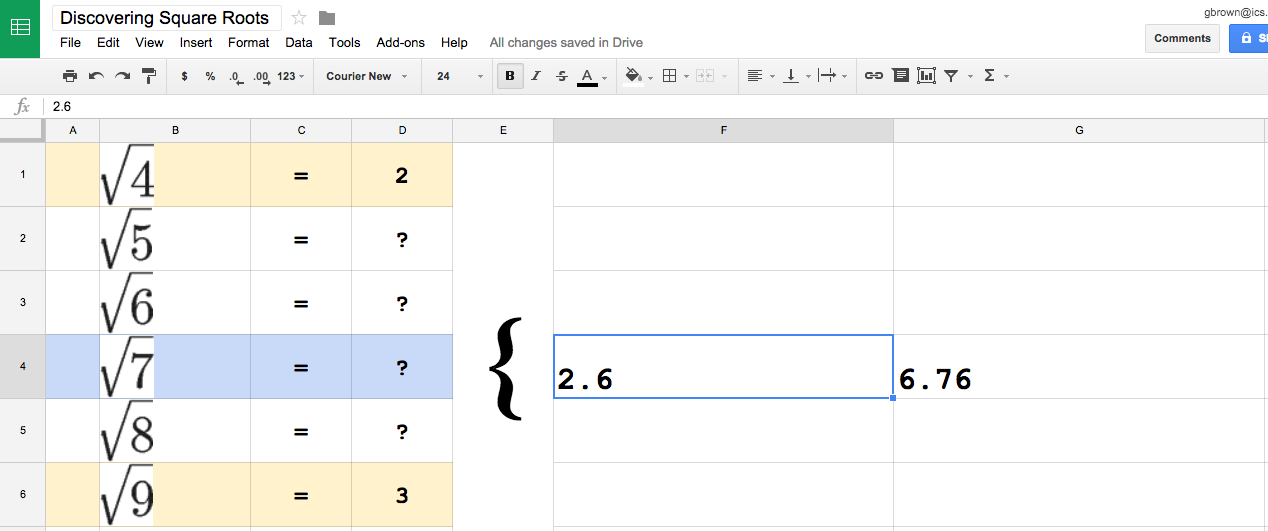
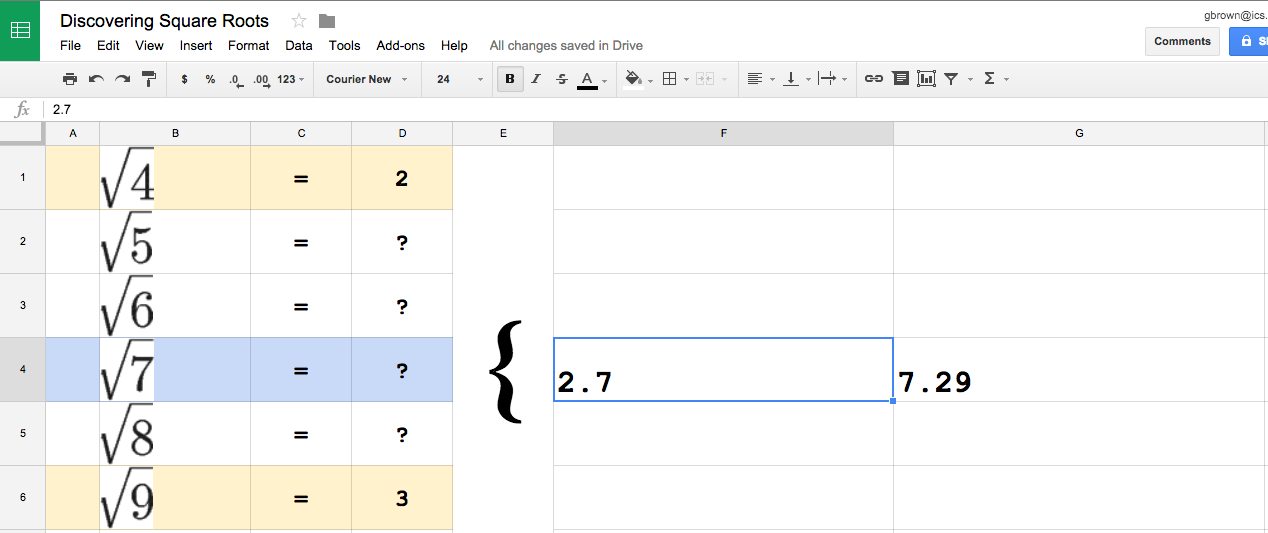
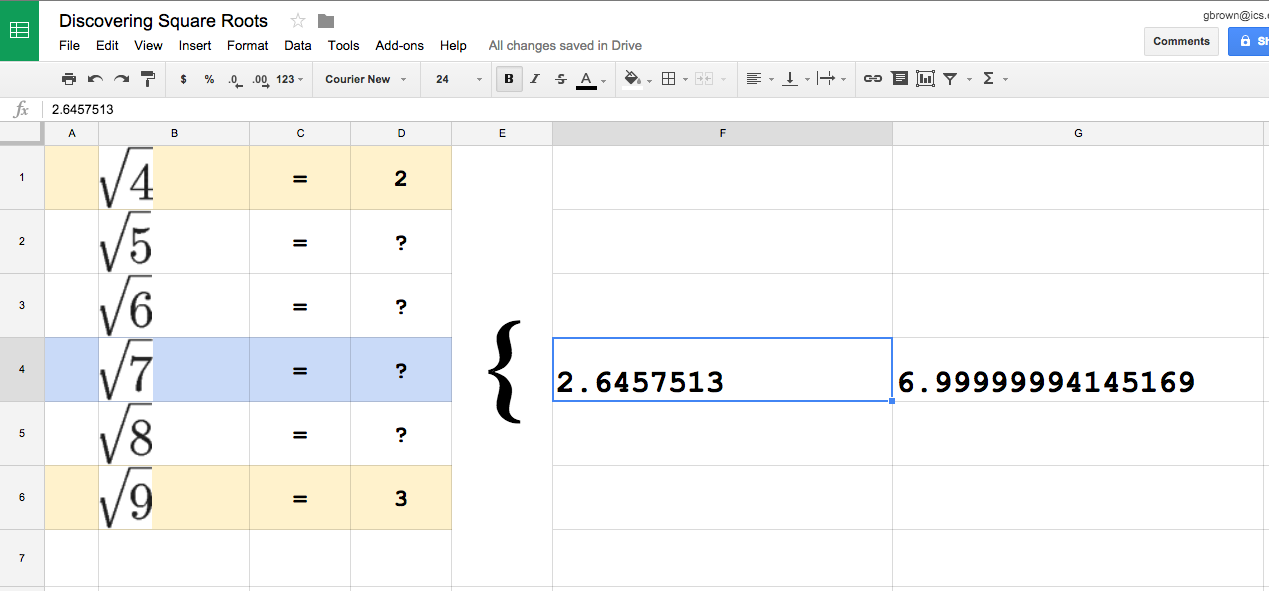
I created a spreadsheet and showed students that √7 is between √4 and √9, which means √7 is between 2 and 3. Students will usually guess 2.6 since √7 is closer to √9 than √4. Once I type 2.6 the spreadsheet automatically calculates the square value of 6.76. This lets us know that our guess of 2.6 is a little small.